
I spent 30 years wondering what to sleep on for optimal sleep and health. When I finally realized through personal experimentation and research that the best mattress is no mattress, I could never look at the world the same. We are asleep when it comes to which bed is the best bed.

A Gebusi woman in New Guinea, decked out in her dance costume, catches a few winks on a woodpile during a male initiation ceremony. (Eileen Knauft) From “Slumber’s Unexplored Landscape” cited below.
I discovered that the mattress is creating and/or masking the body’s current structural imbalances, impeding circulation and hampering the body from realigning itself during sleep. Sleeping on a hard surface can reshape the back and realign the body. A firm sleep surface helps the body’s relationship with gravity, with the earth. This is a therapeutic practice available to all of us, which works while we sleep.
The bedding industry relies on bold claims that one mattress or pillow will outperform another. Some of the claims are tempting, promising a good night’s sleep like you’ve never had before–for only a few thousand dollars.
Where are ‘they’ getting this information? Sleep and health are intricately related. There is no scientific definition of ‘comfort.’ Sleep and especially deep sleep with theta and delta brain waves is known to restore health. How does the actual bed or surface upon which one sleeps affect the quality of sleep?
When I researched for months trying to find an intelligent, scientific article on what type of bed will provide deep, rejuvenating sleep, I could not find it. None of the research seems to know specifically anything about this. The statements are not definitive and claims are not backed up, or are backed up with dubious studies. Even the terms ‘comfort,’ ‘soft,’ and ‘healthy’ are not defined. No studies measure the important health indicators, like pulse, heart rate, levels of stress hormones as related to the type of surface being used.
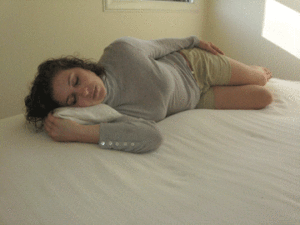
Side sleeping on a firm surface is comfortable using the technique
shown–hips slightly rotated forward, head supported by
firm pillow to expand shoulders.
See Pillow Therapy for more comfortable tips.
Most ‘authorities’ seem confused and baffled. For instance the Mayo Clinic says: “If you have chronic low back pain, you may benefit from sleeping on a medium-firm mattress. Consider trying out a medium-firm mattress before you buy. However, you may find your back pain is reduced with a softer mattress.” (1)
There is no stated cause of low back pain. If the cause is unknown, then the cure must be too. Second, the terms ‘medium firm’ and density are not defined. How can the Mayo Clinic be satisfied with this recommendation, based on absolutely nothing?
I found other statements such as: “a bed shouldn’t be too hard or too soft” or “What works for some people doesn’t work for others.” Sleep science research seems to have completely left out the body and how it interacts with the sleep environment.
What is the specific density of a ‘medium-firm’ mattress, or any other mattress for that matter? Why–in physiological terms–does one surface have a different effect on the body than another surface? What about respiration and air flow through the mattress? Or synthetic vs. non-synthetic? But even more fundamentally: Do we need a mattress at all?I had some hunches–pardon the expression–which started the whole search in the first place. From restorative yoga I got the paradigm that certain positions could induce specific calming responses, relaxing the autonomic nervous system. The New Ergonomics believes the bones need to have some resistance (i.e. a hard surface). From science I knew about the different stages of sleep and how rejuvenating sleep happens during the third and fourth stages. From nutrition I knew that certain vitamins and minerals were needed for the best sleep, and heavy metals in the body can disrupt deeper stages of sleep. Yet the truth of what specific mattress would be optimal for comfort and rejuvenation remained unanswered.
One thing I knew, everyone is dealing with the same thing. Hardly a day passes that I don’t overhear some conversation about sleep, and generally the problem with getting a good night’s sleep.
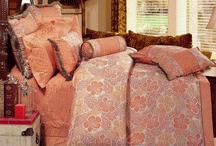
Typical American beds, complete with decorative pillows.
I am skeptical of technological fixes, which are usually touted as the answer to society’s sleeping problems. The extent to the complexity of the bedding industry has become absurd. It is not uncommon for a couple to spend thousands of dollars on the ‘perfect’ mattress system. If this really worked, it would seem that by now, most people at least in America would have solved the sleeping problem and be wide-eye-and-bushy-tailed ready to start the day. But this isn’t the case at all, as anyone who picks up a magazine or watches a few minutes of TV will soon see, with advertisements for sleep aids, sleep drugs, better mattresses, orthopedic pillows, and stimulant drugs.
The assumed paradigm is that a mattress is essential to good sleep just like a chair is essential to sitting. But why did mattresses become mainstream? When did the buffalo robe and pile of leaves go out of fashion? Could a good night’s sleep be had if, for instance, we slept on a sandy beach or the equivalent? Why did ‘they’ start saying a firm bed is best, and still provide a two to three foot thick ‘system’ of mattresses just to get you to that ‘firm bed’ effect?
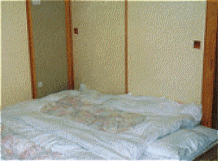
A traditional Japanese Futon ready for sleeping.
Some of the questions came up as I experimented napping and sleeping on different surfaces, including beaches, boulders by the river, grass, and just the bare ground. My conclusion was that almost anything seemed to work, and the best surfaces were those most removed from the modern box-spring bed, the waterbed, or the memory foam bed.
Finally I started turning up some information. A former Japanese health pioneer Katsuzo Nishi published a book in 1927 detailing a system of exercises and practices which include sleeping on a hard surface such as a board, to help with spinal alignment and circulation. Here is an excerpt from the Nishi website.
His theories are characterized by the idea that, in spite of the fact that the human bone structure and positioning of the internal organs are basically the same as those evolved for the mammalian species that ambulate on four legs, human beings’ upright, two-legged life style places certain structural strains on the human bone structure, resulting in problems like obstruction of the flow of food through the intestines (constipation) due to the unnatural (vertical) positioning of the organs. As methods to compensate for these structural defects, Nishi conceived and encouraged the use of treatment through exercises such as the goldfish (movement) style spinal column rectification exercise and the Nishi-shiki health fortifying technique( (lateral vibration exercise know as the “Haifuku Undo”).
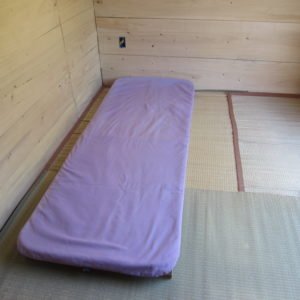
The Paleo Pad™ is a 1/2″ thick wool felt sleeping mat.
Furthermore, based on the structure of the human network of arteries and veins, Nishi refuted the heart-driven blood circulation theory of William Harvey, proposing instead a theory that the capillaries provided the true driving force of the circulatory system. And, in order to compensate for the obstruction of circulation in the four limbs resulting from the human species’ vertical posture, he proposed the Capillary Action- Inducing exercise (Mokan Undo), which involves lying on the back, raising the arms and legs and applying a slight vibrating motion.
Besides these exercises, Nishi also recommended methods making use of implements like a hard, half –cylinder pillow, design to keep the cerebral vertebrae in the ideal position from a structural standpoint and a flat sleeping platform (flat board) designed to do the same for the vertebrae of the spinal column. (2)
This is at least anecdotal evidence that mattresses in general are bad for our health from a structural and metabolic perspective. Whether they are brand new or worn out makes no difference. My hypothesis is that mattresses insulate us from our experience of our body. They do not allow the resistance that we need to keep us in alignment and optimize breathing and circulation. When it comes to a mattress, more is not better. Less is better.
The whole concept of a mattress, a deep, soft place to rest our tired bones, is mistaken. More rejuvenation comes from less fluff. It doesn’t take something two feet thick to provide the hardness of a simple cot or a pallet on the floor. The traditional Japanese had it right with their sitting as well as their sleeping. Their mattresses (futons) are about the thickness of a typical quilt. No doubt, Nishi’s recommendations had something to do with the reason that some Japanese people still use traditional Japanese sleeping habits, even though Western furniture is available.
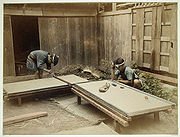
Japanese men making traditional tatami Mats around 1900.
Yet again I was experimenting–this time sleeping on a thin cotton blanket folded in half. I could hardly believe it. After all these years of troubling over having a good bed, even what was considered a hard bed, to my surprise, I actually slept at least as well on practically nothing. I’m not saying it felt luxurious or soft, but I slept well and felt even better upon awakening. I could see what Nishi was saying about improved circulation to the extremities. When the surface is very firm like a board, there is nothing to push up against the muscles. The bones take the brunt of the pressure so the muscles with arteries and veins and free. I also wonder if perhaps this resistance against the bones might encourage bone density while we sleep, and soft mattresses therefore might influence bone loss. This would make a great study but I can’t find any already performed.
Here is a travel log written by a recent traveler to Japan
Although many Japanese sleep in beds these days, it is still common to sleep on a futon mattress spread on the floor. Westerners call the small couch which turns into a bed a futon, but that is very different from the traditional Japanese futon. A traditional Japanese futon set includes shikibuton (under futon), kakebuton (comforters), and makura (pillow)… Shikibuton is usually stuffed with cotton batting and is wrapped in shikifu (sheets). Japanese uses different types of futon, depending on the season, such as light ones in summer and heavy ones in winter. Futon made from down feathers is light and comfortable but is most expensive. Kakebuton is covered by kakebuton cover. The traditional Japanese pillow (makura) is filled with red beans or buckwheat chaff… Futon is usually put away during the day in the closet called oshiire. The oshiire closet has sliding doors and usually divided into two shelves. It is best to keep the futon on the upper shelf. Japanese houses are usually small and do not have many rooms, so a room is used for dual purposes. During the day, a room can be used as workroom or guestroom after futon is stored in the oshiire. It is very convenient… It is important to sometimes dry futon under direct sunshine. You may ruin your futon if you keep them in the closet or spread on the floor all the time. Remember that Japan is very humid especially in rainy season. There is a product called futon kansouki (futon dryer) in Japan. Just place the dryer between kakebuton and shikibuton while it is spread on the floor. Airing your futon really helps you sleep well… Also, it is commonly said that sleeping on futon is better for the back than sleeping on a soft bed. The hardness of the floor seems to be good for people who have back problems.
In an article in Science News called “Slumber’s Unexplored Landscape: People in Traditional Societies Sleep in Eye-opening Ways,” Bruce Bower explains why I have had such a hard time finding real information on sleep patterns, behavior, and biology—because—according to Bruce Bower–it has been an ’embarrassingly’ overlooked area of anthropology.
“Adult sleepers in traditional societies recline on skins, mats, wooden platforms, the ground, or just about anything except a thick, springy mattress. Pillows or head supports are rare, and people doze in whatever they happen to be wearing. Virtually no one, including children, keeps a regular bedtime. Individuals tend to slip in and out of slumber several times during the night. In these unplugged worlds, darkness greatly limits activity and determines the time allotted to sleep. Folks there frequently complain of getting too much sleep, not too little.” (3)
My instigating hypothesis that modern beds (mattresses) are not needed and possibly counter-productive was starting to prove plausible. The article also says that a single stint of total sleep–that is the accepted norm by today’s sleep ‘experts’–was not normal for pre-industrial societies and that the advent of artificial lighting has altered the body’s natural circadian rhythms. From reading the few studies conducted on native people’s sleep patterns, one can easily surmise we are barking up the wrong tree when we think a NASA designed mattress will solve our sleep problems.
According to an article on WebMD, there are no independent studies showing any bed or mattress has healing powers. “Consumers shouldn’t be lured by claims of therapeutic benefits for beds,” says Charles Cefalu, MD, spokesman for the American Geriatrics Society. He says that “the only beds that can claim to be therapeutic are prescribed by physicians for home use and have the same technology as therapeutic beds used in hospitals to treat burn victims.”
This article goes on to say that firm surfaces may be problematic, especially for older sleepers or those with arthritis. It does say, however, that most of these problems can be alleviated with propping and bolstering pillows– especially a pillow under the back of the knees when sleeping on the back.
A mattress in any true sense of the word causes the hips to sink in and the lower back to collapse, which interrupts natural alignment. Ironically, this is the same effect that chair sitting has on the body. When the back collapses in on itself, whether sitting or lying down, the lungs cannot hold as much oxygen and breathing is immediately hampered. When the body does not get its optimal amount of oxygen, the parasympathetic nervous system which induces relaxation is impeded. When breathing is shallow, the stress hormones adrenaline and cortisol are overproduced–which keeps the body from fully relaxing.
The viewpoint of followers of the New Ergonomics is that chair sitting causes ‘front loading’ of the body (see Challenges to Natural Sitting). Since the muscles are tighter in front, the body feels better hunched over to some degree. Likewise, sleeping on a modern mattress causes slumping. Then when we lie down on a firm surface, tight muscles are stretched, which feels uncomfortable. Therefore, we have gotten dependent on a soft bed to maintain the out-of-alignment position, or posture of flexion. It may feel better and even help some people sleep better, because they aren’t being distracted by the body’s attempt to stretch and realign itself. But without the feedback a hard surface offers, deeper problems develop and we don’t reach our full potential.
If the mattress does play some role in improving sleep, the best mattress is not a mattress at all, but something more like a pad or a pallet on the floor–something that comes the closest to mimicking the very ground from which humans evolved.
How to Sleep on a Firm or Hard Surface
Of course when first lying down and sleeping on a hard surface, you are probably going to feel uncomfortable. And what is meant by a ‘hard’ surface? I have personally tested various beds, futons, and natural surfaces over several decades and have come to the conclusion that what mattress manufacturers call ‘firm’ or ‘hard’ does not even come close to the traditional Japanese futon. What describes this quality best is a thick quilt on a floor or board. That bit of padding (about one to two inches of compressed padding) won’t let the hips sink in to mis-align the spine, yet it buffers the body somewhat.
From my own experimenting and interviewing people, I have come to the conclusion that this amount of firmness is what works for most Americans who are changing their lifestyle and sleeping habits. You will need to experiment for yourself to see what works. You can start with napping and later try sleeping this way. It may take more than one night to get used to it. You can gradually go to a harder surface and compare the results.

The modular platform bed the author designed using a blend of traditional Japanese with modest western touches.
The interesting thing I have found upon informally interviewing people who have tried sleeping on firm surfaces is that they complain about it being hard and less comfortable, and yet they sleep very well and feel refreshed upon awakening. You can sleep on a ‘platform bed’ or the floor. A ‘platform bed” is a simple raised surface where your mat goes, but does not have a true mattress. The platform bed is best for those who don’t want to get down to the floor level. It’s disadvantage is it can’t be put away during the day.
The Japanese use a tatami mat under the futon. This provides ventilation underneath which helps regulate body temperature as well as keep the futon from becoming damp with the body’s persperation. It also keeps the futon, blanets, and pillows off the floor which might be dirty and drafty. This is a great invention, but is expensive and doesn’t always fit in with a person’s interior design. A simple tatami mat imitation can be easily handmade from lumber. All that is needed is a slatted surface raised a few inches off the floor. Or the platform bed can serve as a tatami mat if it has a slatted surface.
People with health issues such as arthritis, scoliosis, rheumatism, or weak capillaries will need to use common sense and not go to as hard a surface as healthier individuals. What you are aiming for is a ‘spine-neutral’ position. Neutral spine is the natural position of the spine when all 3 curves of the spine — cervical (neck), thoracic (middle) and lumbar (lower) — are present and in good alignment.
The type of comfort one feels on a hard surface is more of an acquired taste. It is similar to the difference between Wonder Bread and old fashioned sourdough bread. One is soft and empty, one is solid and wholesome. You will feel your hips and shoulders rubbing against the surface and you won’t sink in as before. Unfamiliarity is not comfortable. It is comforting in the way it helps you breathe more fully, the way it grounds your body, the way it reassures you that there is something solid somewhere in life that you can always count on.
At first you may feel like it’s impossible to relax, because it contradicts all your ideas about relaxation. You are feeling your life energy, the place your body comes up against the earth. You will know where you are out of alignment. Give it some time. Common sense and a spirit of adventure go a long way.
Sleeping in this way resembles restorative yoga, and props can be used in much the same way. The goal is to position the body so it is relaxed and comfortable. There are several supports, bolsters, and pillows which can be propped in any number of ways depending on individual needs. For instance, for lower back pain, place a small support under the lower back (when lying on your back). A rolled up sock will work, but a flax seed eye pillow is the ultimate size and shapes just the right amount. Or alternatively, place a bolster behind the knees.
When side sleeping, hug a large pillow and put a pillow between your knees–or use a body pillow. Also, make sure your head pillow is tall enough. It should be about 5 inches (for most people) when compressed–your head should not be pushed up or down but paralell with the bed.
I believe the reason mattresses have become ubiquitus is mainly due to these reasons:
1–The perceived comfort is an adaptive response. The body becomes ‘front-loaded’ due to facters such as chair sitting and mattresses. When the body stretches and lengthens on a firm surface, those tight muscles and ligaments are stretched and noticed, causing discomfort.
2–The psychosomatic aspect of a mattress: It looks thick and plush, therefore it MUST be comfortable.
3–Since mattresses have been around for so long, no-one even questions their usefulness. Therefore no studies are performed.
4–The propaganda of a century of advertising. In reality that mattress is creating and/or masking the body’s current structural imbalances, impeding circulation and hampering the body from realigning itself during sleep. Sleeping on a hard surface can reshape the back and realign the body. A firm sleep surface helps the body’s relationship with gravity, with the earth. This is a therapeutic practice available to all of us, which works while we sleep.
References
(1) The Mayo Clinic’s recommendations on buying a mattress http://www.mayoclinic.com/health/buying-a-mattress/AN01641 (As of 07/29/09 the article appears to have been removed. Sorry for the searing critque.) They now have a nice article on tips for better sleep here.
(2) Nishi Hard Surface
When the body is placed this flat on a hard leveled bed, the weight is most equitably distributed, the muscles are given he maximum relaxation; and any subluxation or deflexure of the spine caused by the upright posture during the daytime is easily corrected; furthermore, the very hardness of the bed secures the functional activities of the skin and prevents the liver from becoming sluggish and moreover stimulates the veins distributed superficially all over he body so as to promote the return of the blood towards the heart. This in turn leads to the inversing activity of the liver, with the result that all the waste matter which have been deposited during the daytime will be swept away from the body and the motor nerves will be kept from any undue pressure or strain. Moreover the intestines will be secured against constipation or stasis. This you will be sure to get a good sleep and awake the next morning quite refreshed mentally or physically.
Hard Half Cylindar Pillow
When using the solid pillow you should lie flat and place the neck on the pillow so that the third or fourth cervical vertebra may be properly rested on it. Needless to say that one who is not accustomed to such a pillow would find it painful. In that case, a towel or some other soft piece of cloth may be laid over it. It is to be remembered that you should, however, take the piece of cloth off now and then and try to gradually accustom yourself to he hardness. Thus you would in time become accustomed to it and sleep comfortably without using any such softener. Effects: The use of the solid pillow has the beneficial effect of preventing or correcting any subluxation of the cervical vertebrae and helping to prevent headaches, meningitis, as wall as diseases of the ear, nose and throat. Moreover it keeps the brain and spinal cord in a normal tone necessary for their proper function and thus keeps off any sluggish or paralytic disorder in the body, especially in the nerves and limbs.
How to get started? Click here for part Two of Sweet Dreams on a Hard Surface
References
(1) The Mayo Clinic’s recommendations on buying a mattress http://www.mayoclinic.com/health/buying-a-mattress/AN01641 (As of 07/29/09 the article appears to have been removed. Sorry for the searing critque.) They now have a nice article on tips for better sleep here.
(2) Nishi Hard Surface When the body is placed this flat on a hard leveled bed, the weight is most equitably distributed, the muscles are given he maximum relaxation; and any subluxation or deflexure of the spine caused by the upright posture during the daytime is easily corrected; furthermore, the very hardness of the bed secures the functional activities of the skin and prevents the liver from becoming sluggish and moreover stimulates the veins distributed superficially all over he body so as to promote the return of the blood towards the heart. This in turn leads to the inversing activity of the liver, with the result that all the waste matter which have been deposited during the daytime will be swept away from the body and the motor nerves will be kept from any undue pressure or strain. Moreover the intestines will be secured against constipation or stasis. This you will be sure to get a good sleep and awake the next morning quite refreshed mentally or physically. Hard Half Cylindar Pillow When using the solid pillow you should lie flat and place the neck on the pillow so that the third or fourth cervical vertebra may be properly rested on it. Needless to say that one who is not accustomed to such a pillow would find it painful. In that case, a towel or some other soft piece of cloth may be laid over it. It is to be remembered that you should, however, take the piece of cloth off now and then and try to gradually accustom yourself to he hardness. Thus you would in time become accustomed to it and sleep comfortably without using any such softener. Effects: The use of the solid pillow has the beneficial effect of preventing or correcting any subluxation of the cervical vertebrae and helping to prevent headaches, meningitis, as wall as diseases of the ear, nose and throat. Moreover it keeps the brain and spinal cord in a normal tone necessary for their proper function and thus keeps off any sluggish or paralytic disorder in the body, especially in the nerves and limbs. Click here to visit the Nishi Wiki page.
(3) Here is the link to the Bruce Bower’s article: Slumber’s Unexplored Landscape:
(4) Here is the link to the WebMD article about beds:
http://www.webmd.com/back-pain/news/20080403/soft-bed-or-hard-bed-for-back-pain
(5) Here is an interesting testimonial from someone who has tried out the ideas in this article.
http://blog.modernpaleo.com/search/label/Sleep
(6) Instinctive sleeping and resting postures: an anthropological and zoological approach to treatment of low back and joint pain Michael Tetley, physiotherapist
http://www.ncbi.nlm.nih.gov/pmc/articles/PMC1119282/
*The statements on this website have not been evaluated by the FDA. These statements and the suggestions mentioned are not intended to diagnose, prescribe for, treat or claim to prevent, mitigate or cure any human disease. As always, please consult a trusted and knowledgable health care provider before beginning any new activity.
How to Maintain a Japanese Futon
© 2006 By Patrick Clark