The entire contents of this website are copywrited © by Carolina Morning Designs. Reprinting for commercial use is by written permission only. Contact our webmaster.
Organic, Earth Friendly
Pillows
are breatheable, have no toxic offgassing, and are designed to facilitate optimal alignment, breathing, and true comfort.
The true 'yoga furniture'

Japanese style buckwheat pillows
Eye pillows
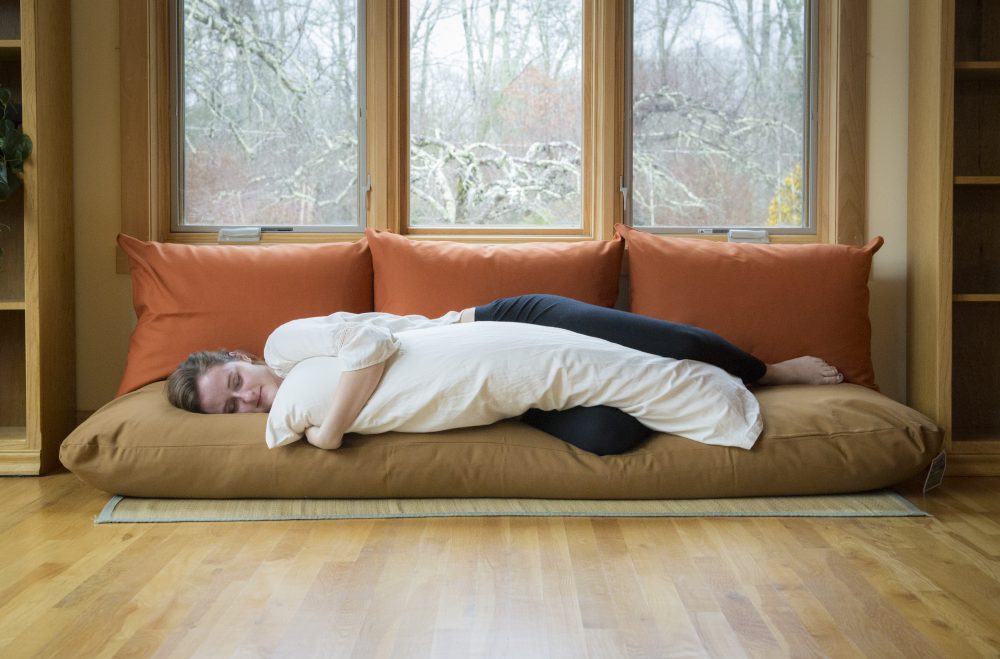
Body pillows
Yoga bolsters
Mini Futons
Yoga Mats

These pillows help alleviate back pain while sleeping or lounging and encourage an aligned body and restorative sleep.

We design pillows with the principles of the New Ergonomics and the somatic arts. Unlike Western home furnishings designed for fashion and pomp, our pillows offer a practical yet elegant atmosphere to the home.

We offer a limited variety of pillows which offer a wide range of uses. Our yoga bolsters can be used to form a "lounge" position for use on a bed or floor. This is a very comfortable position for reading, writing, or other activities when you want to rest your back with no strain on your neck. Use a lap pillow (our Smile Cushion™ works well for this) to prop a book or laptop computer.

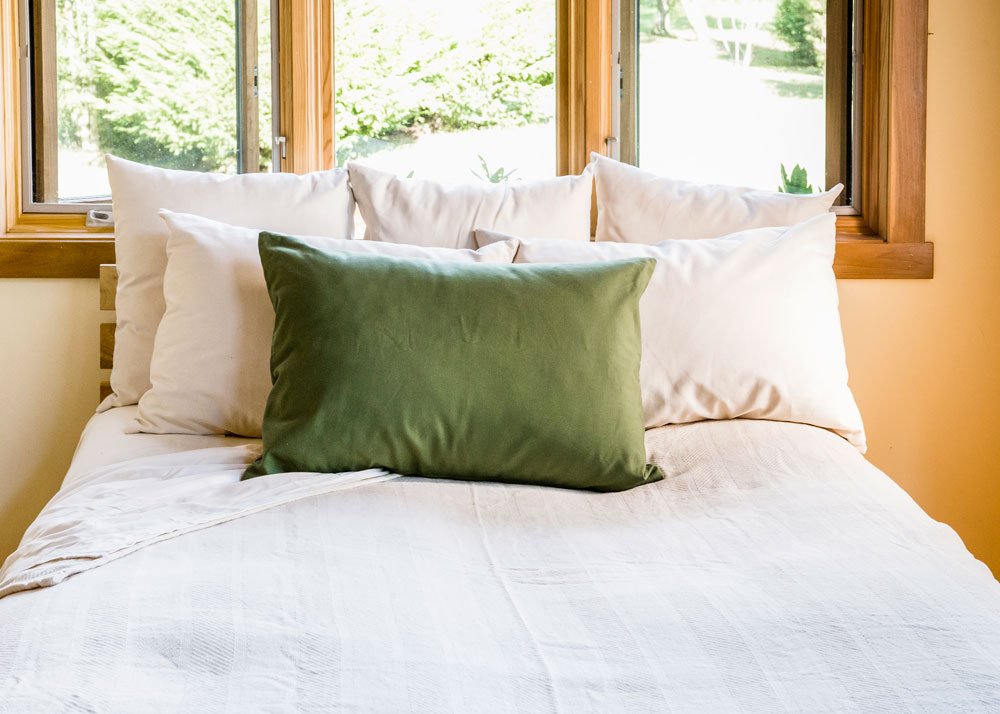
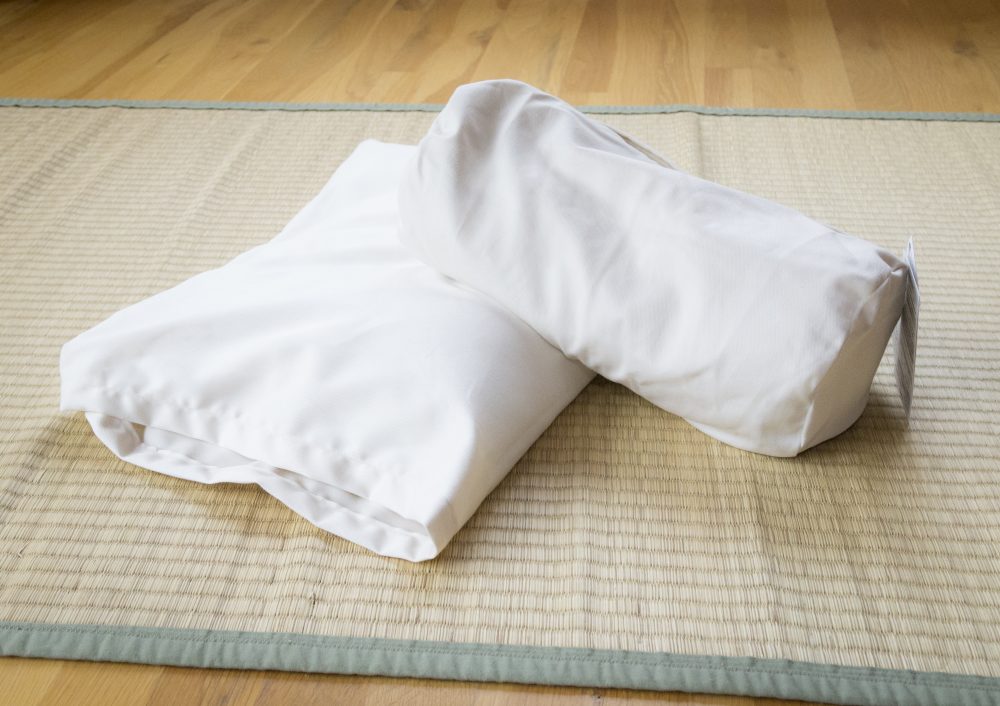
Our Japanese buckwheat pillows support the neck and are moldable to conform to whatever shape you need at any particular time. These pillows can help realign the neck which gets pushed too far forward from chair sitting. Overstuffed western pillows only push the head too far forward which may "feel" comfortable but is actually maintaining a forward jutting head (lardosis). In this case, BIGGER is not BETTER. For side-sleeping, stack two pillows together or fold your rectangular pillow in half. Also, to cut out noise, place a pillow on each side of the head, covering your ears.

Eye pillows quieten the muscles around the eyes and this quietens the brain. This is very effective at helping some people relax easier and faster. Eye pillows also block out the light which is another reason they can help with deeper sleep. Fresh picked organic lavendar petals from a local farm add soothing aromatherapy for those who like it.

An eye pillow can also be used to support the lower back while sleeping on a firm surface. Simply place it at the lower back and it will make a firm surface feel much more comfortable, and alleviate the main purpose of a soft mattress.


The Body Pillow offers relief from the effects of gravity.

Here is how is works: Side sleeping can collapse the shoulders and hips. But when hugging this big pillow, the shoulders and chest are kept wide. At the same time the pillow goes between the knees to keep the hips wide. Widening the chest allows deeper breathing and relaxation, and the fetal curl is the best sleeping position according to some chiropractors.

Our kapok stuffed body pillows are sewn with organic cotton fabric, which makes them breathable to prevent sweating. We stuff our body pillow firmly, which provides more support. We recommend placing your head on a buckwheat pillow and NOT the body pillow. Placing the head on the body pillow, as shown on many websites, will result in a stiff neck because it pushes the neck out of alignment. Our body pillow is small to make it much easier to move it out of the way when not using it. When the head isn't placed on the body pillow, it doesn't need to be as long. The body pillow doubles as an excellent bolster under the knees. It can be placed at the back of the bed during the day.

YOGA BOLSTERS without the chemicals of cotton

Organic Yoga Bolsters are hard to find, but well worth the extra price to practice living gently on the earth and to protect yourself from the offgassing of flame retardens and formaldehyde added to cotton batting. Yoga bolsters are used for restorative yoga poses, especially back stretching. Little do most people know, they also make an incredible piece of furniture. The rectangular bolster can be used as a backrest either in the 'yoga lounge' shown or by itself on the floor or bed. The cylindar bolster makes a raised 'massage table' when lying in prone position face down. The cylindar bolster can also be used as a body pillow or to prop the feet up when lying in bed.

Stuffed firmly with environmentally-friendly kapok, this 100% cotton muslin cushion comes with a zippered, washable, 100% cotton cover. Features a handle on one end for convenient carrying.

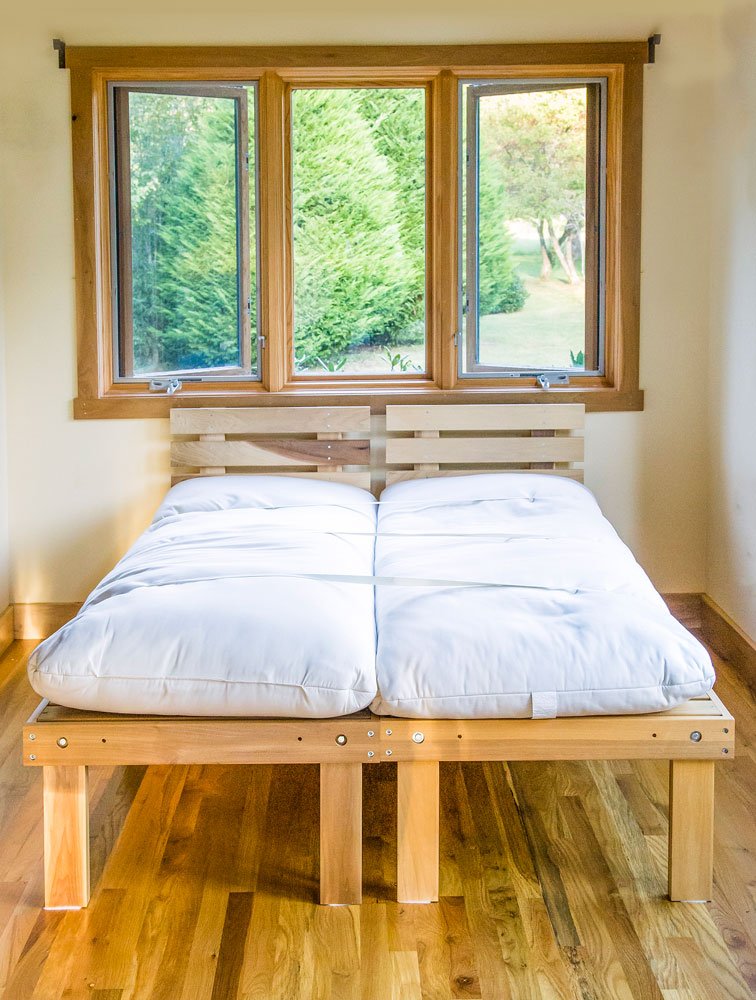
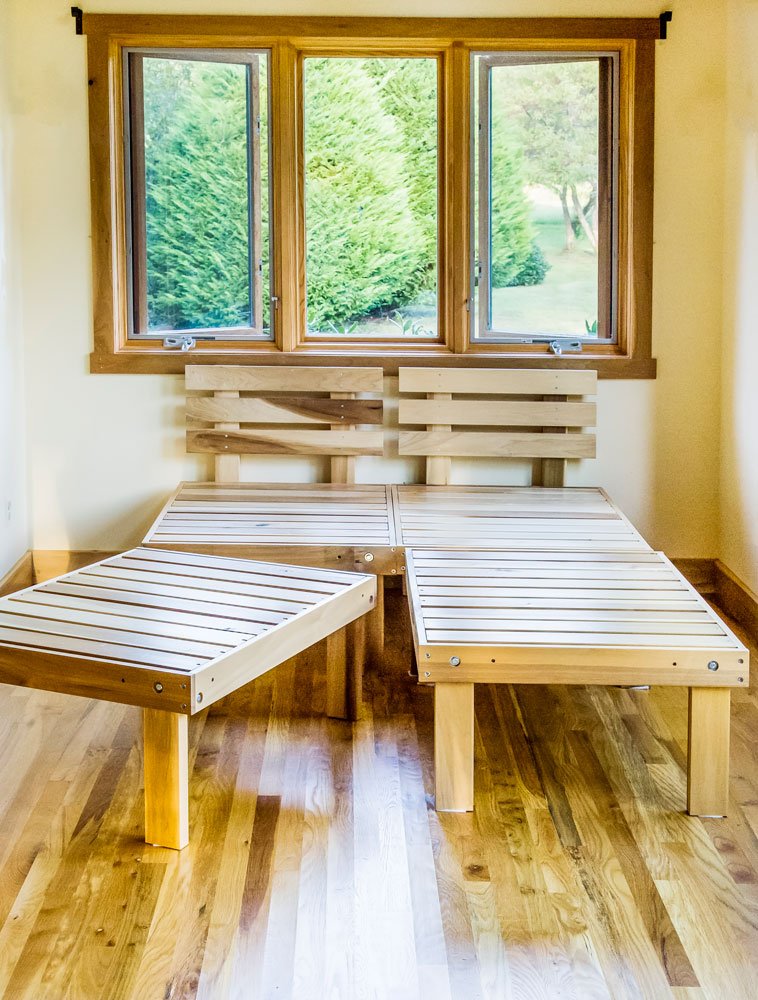
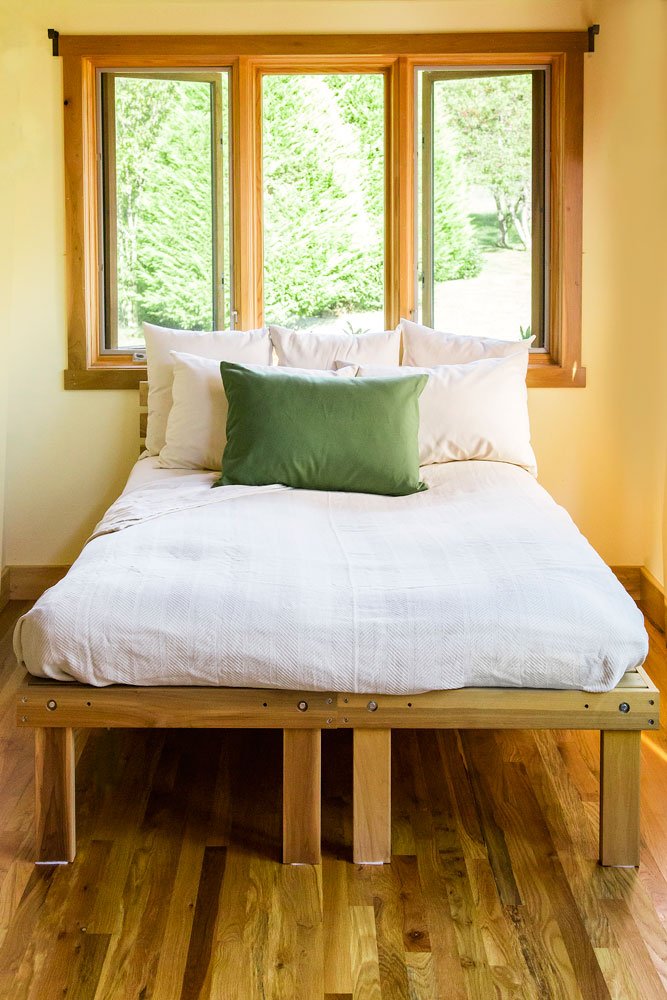
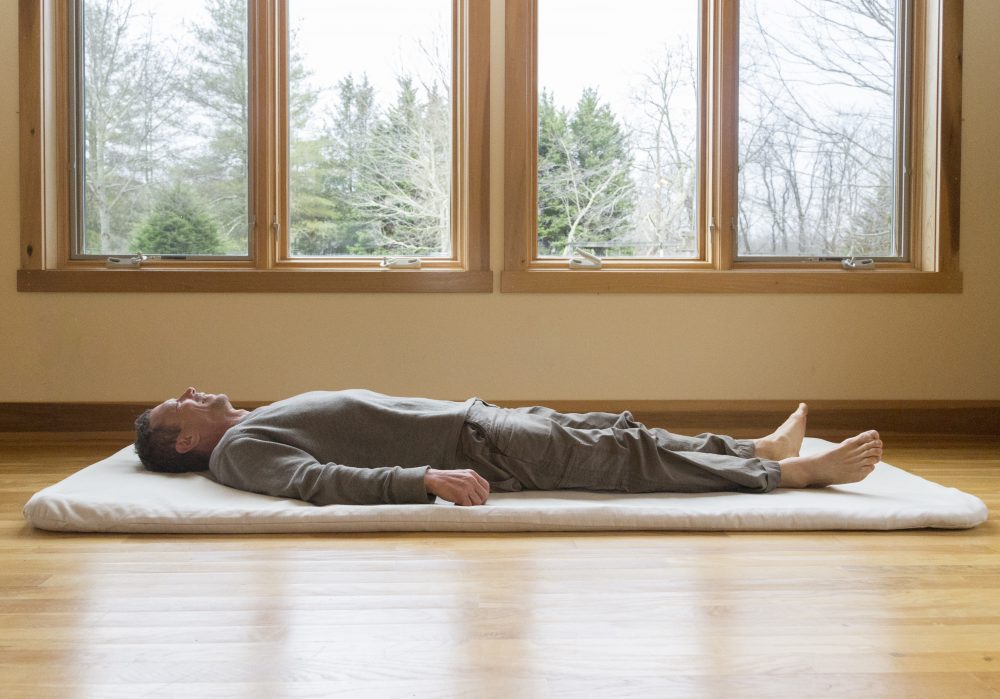
Our yoga mat is really a traditional Japanese futon which can be used as a simple bed. Two side-by-side covered with a mattress pad or a simple blanket to hide the crack makes a Double or Full sized bed. This acts essentially as a single unit and has the advantage of being easy to move and put away. Stuffed with kapok which is a chemical free-mold and dustmite proof material sustainably gown in Asia.

This is the original, traditional, Japanese futon: a simple bed that can be rolled up during the day and stored in a closet. The futons you see in stores are Americanized, hardly adhering to the function of the original item. They are more of a mattress than a futon. Kapok is breathable, non-toxic, and doesn't compress over time like cotton batting. If you like a firm surface--it makes an excellent bed, for every-night use or company. Many health care experts recommend a firm bed for a healthy back. Dr. Nishi, a former Japanese pioneer in the health benefits of sleeping on a firm surface, believed this type of bed alleviates many health problems, especially related to circulation and back issues.

Western furniture is built on the flawed paradigm of the 'table-and-chair-culture". We offer a revolutionary, freeing, and movement-frendly alternative to your home, office and studio.

To learn more about how to create restorative, movement-friendly spaces, sign up for our newsletter. For sleeping ergonomics, click here.

Yoga and Meditation

SEATS
Zafu Cushion
Peace Bench™
Sky Bench™
Smile Cushion™
Inflatable Zafu
Tilt Seat™

MATS
Zabuton
Yoga Mat
Mini Futon
Sticky Mat
Yoga Lounge™

YOGA PROPS
Straps
Blocks
Bolsters
Sticky Mats

FURNITURE
Desks
Chairs
Bookshelf
Z
en Office™
Floor Bedding

PILLOWS
Head Pillows
Eye Pillows
Body Pillows

ACCESSORIES
Books/CDs
Beeswax Candles
Meditation Bells
Kapok and Buckwheat

We love to talk--call us!
1-888-267-5366
Contact
Free Brochure
Newsletter Sign Up

We love nature.

Home | Colors/fabric | About us | Wholesale | Discounts | Order Info | Retail Outlets | Green Lifestyle | View Cart | Check Out
Specifics:

All head pillows have two layers. The inside is 100% cotton ticking. The outer cover is 100% organic cotton sateen. Sateen is very soft, 240 thread count, off white fabric.

Body pillows are made with 100% cotton muslin inside with removable sateen case.

Bolsters have an inner muslin case with a zippered, removable cover of canvas or twill. All pillows and cushions have an opening which allows addition or removal of stuffing material to adjust to individual height/density.

Simple Sleeping comfort:
body pillow, buckwheat pillow, rectangular, buckwheat pillow cylindrical, eye pillow, sitting on top of a bed made of two yoga mats.

The Yoga Lounge:
Yoga Mat, Yoga Bolster Rectangular, Yoga Bolster Cylindrical, Buckwheat Pillow Cylindrical, Yoga Blocks holding up the Yoga Bolster.

buckwheat pillow, cylindrical
[16" X 8" diameter", 2lbs]
organic sateen
$38.00

buckwheat pillow, cylindrical
organic cactus
$38.00

extra pillow case-
cylindrical
organic sateen
$20.00
extra pillow case-cylindrical
organic cactus
$20.00

buckwheat pillow, rectangular
[16" X 8" diameter", 2lbs] organic sateen
$40.00

buckwheat pillow, rectangular
[16" X 8" diameter", 2lbs]
organic cactus
$40.00

extra pillow case-rectangular
organic sateen
$20.00

extra pillow case-rectangular
organic cactus
$20.00

Kapok Body Pillow
[4' 2" long x 8 inches diameter ", 4lbs]
Filled with kapok.

Organic Eye Pillow Batik/ Unscented
$14.00
Organic Eye Pillow Sateen/ Unscented/ Flax seed
$14.00
Organic Eye Pillow Batik/ Lavender Petals
$16.00
Organic Eye Pillow Sateen/ Lavender Petals/flax seed
$16.00
[3.5"x7"]

Removable case allows easy cleaning.

filled with 13 ounces of organic flax seed

body pillow
Organic Sateen
$59.50
body pillow
Organic Cactus
$59.50
Mini-Futon/Yoga Mat
12lbs.
[27"x76"x2"]
Yoga Mat/Kapok Mini Futon
organic taupe

$130

Yoga Bolster
Cylindrical
deep purple
27"x9"diameter
4 pounds
$64.00

Yoga Bolster
Cylindrical
organic taupe
27"x9"diameter
4 pounds

$64.00
Yoga Lounge™
Organic Taupe
(buckwheat pillow is sateen)
$275.20
Yoga Lounge™

A $344.00 value for only $275.20 (you save 20%--$68.80)

Shipping charges will be more than what is reflected on your cart. We will email the actual shipping charges.

**no further discounts apply**

includes:

Restorative Yoga Mat, Yoga Bolster Rectangular, Yoga Bolster Cylindrical, Buckwheat Pillow Cylindrical, 2 Buckwheat Yoga Blocks holding up the Yoga Bolster.

Removable cover for the Yoga Mat is available separately.

***Shipping and Handling charges for the Yoga Lounge will be higher than what you see on your order!! The reason: it is bulky, thus needs a bigger box, and normal rates don't apply. We will notify you by email of your actual charges before we begin processing your order***

The Ergonomics of Sleep:
Integrating Yoga, Science, Nutrition and Anthropology for the Best Night’s Sleep

by Patrick Clark

When I searched the Internet for an intelligable, scientific article or book on how sleep works, what is the best environment for quality sleep, and what type of bed, blanket, and pillow will provide the deepest, most rejuvenating sleep, I could not find it. I tried all kinds of keywords and phrases, yet none of the articles seemed to know specifically anything. Most “authorities” seemed confused and baffled. For instance I found statements such as: “a bed shouldn’t be too hard or too soft”; "What works for some people doesn’t work for others”, “Comfort is a matter of subjective perception.” Yet the advertising media is nothing but bold claims that one mattress or pillow will outperform any other. I have to admit some of the claims were tempting, promising a good night's sleep like you've never had before, for only a couple thousand dollors.

I had some hunches, which started the whole search in the first place. From restorative yoga I got the paradigm that certain positions could induce specific calming responses, relaxing the autonomous nervous system. From somatic education and the New Ergonomics I learned certain principles such as: the bones need to have some resistance (i.e. a hard surface). From science I knew about the different stages of sleep, and how rejuvinative sleep happens during REM which is the last phase of a four hour sleep cycle when we are dreaming. From nutrition I knew that certain vitamins and minerals were needed for the best sleep, and heavy metals such as mercury can disrupt sleep or certain stages of sleep by pushing out essential minerals and blocking needed homones. Yet the truth of what specific mattress or pillow would help one sleep comfortably and with the most rejuvenative effect remained unanswered.

One thing I knew, everyone is dealing with the same thing. Hardly a day passes that I don't overhear some conversation about sleep, and generally the problem with getting a good night’s sleep. Our society is addicted to coffee, which basically says as plain as the nose on your face that there is a problem with sleep. If we slept well, then why would we need something to ‘wake us up”.

I am skeptical of technological fixes, which are usually touted as the answer to society’s sleeping problems. The extent to the complexity of the bedding industry has become absurd. It is not uncommon for a couple to spend thousands of dollars on the ‘perfect’ mattress system. If all this really worked, it would seem that by now, most people at least in America would have solved the sleeping problem and be off of coffee, wide-eye-and-bushy-tailed ready to start the day. But this isn’t the case at all, as anyone who picks up a magazine or watches a few minutes of TV will soon see, with advertisements for sleep aids, sleep drugs, better mattresses, orthopedic pillows, and stimulant drugs like coffee.

According to most scientists, Homo sapiens have been around for millions of years. Common sense and a little research will tell you mattresses have been around for much less. (a couple hundred years in Europe.)  Yet the paradigm of most of civilization is that a mattress is essential to good sleep, just like a chair is essential to sitting.

Why did mattresses become mainstream? When did the buffalo robe and pile of leaves go out of fashion? Could a good night’s sleep be had if, for instance, we slept on a sandy beach or the equivalent? Why did ‘they’ start saying a firm bed is best, and still provide a two to three foot thick ‘system’ of mattresses just to get you to that “firm bed” effect? Some of the questions came up as I myself experimented napping and sleeping on different surfaces, including beaches, boulders by the river, grass, and just the bare ground. My conclusion was that almost anything seemed to work, and the best surfaces were those most removed from the modern box-spring bed, the waterbed, or the memory foam bed.

Finally I started turning up some information from a former Japanese health pioneer Katsuzo Nishi. This  man published a book in 1927 detailing a system of excersizes and practices which include sleeping on a hard surface such as a board, to help with spinal alignment and circulation.

Then I found another article in Science News--Slumber's Unexplored Landscape: People in Traditional Societies Sleep in Eye-opening Ways,  By Bruce Bower. This article explains why I have had such a hard time finding real information on sleep patterns, behavior, and biology—because—according to Bruce Bower--it has been an “embarrassingly” overlooked area of anthropology.

"Adult sleepers in traditional societies recline on skins, mats, wooden platforms, the ground, or just about anything except a thick, springy mattress. Pillows or head supports are rare, and people doze in whatever they happen to be wearing. Virtually no one, including children, keeps a regular bedtime. Individuals tend to slip in and out of slumber several times during the night. In these unplugged worlds, darkness greatly limits activity and determines the time allotted to sleep. Folks there frequently complain of getting too much sleep, not too little."

My instigating hypothesis that modern beds are not needed and possibly counter-productive was starting to prove plausable. The article also says that a single stint of total sleep--that is the accepted norm by today's sleep 'experts'--was not the case at all for pre-industrial societies and that the advent of artificial lighting has altered the body's natural circadian rythms. From reading the few studies conducted on native people's sleep patterns, one can easily surmise we are barking up the wrong tree when we think the right mattress will solve our sleep problems.

On my preliminary search, I believe that toxins which outgass from memory foam and other sythetic bedding materials (endocrine disrupters, phytoestrogens), electromagnetic fields found from nearby powerlines, transformers, and, electrical outlets, metal coiled boxsprings which amplify electromagnetic fields, and unnatural sleep hours brought on by artificial lighting probably effect our quality of sleep more than any particular mattress. But the best evidence of our nation's sleep problems points to an even more ubiquitous problem: hypothyroidism. According to Dr. Lita Lee, chronic insomnia or lack of quality sleep is one symptom of a major health condition which leads to all the major degenerative diseases and aging. By understanding this problem, one can reverse the aging process, restore quality sleep, and get off of medications. She has a great article on how to heal insomnia here.


Sign up for our newsletter to get the remainder of this article when it is published.

Yoga Bolster
Rectangular
25"x6"x12"
4 pounds
organic taupe
$64.00
Yoga Bolster
Rectangular
25"x6"x12"
4 pounds
deep purple
$64.00